Create your own Playlist on LessonPaths!
Wednesday, March 5, 2014

Tuesday, March 4, 2014
I/D# 2: Unit O Concept 7-8
Inquiry Activity Summary

(http://upload.wikimedia.org/wikipedia/commons/6/68/30-60-90.svg)30-60-90º Triangle
1. In this 30-60-90º triangle the ratios that make up this triangle is literally
1:2:3 that respectively measure 30-60-90º angles in this special right
triangle. So, in this special right triangle we are given that that this is a 30-
60-90º and so basically what that means is how and why do we get the
 numbers that are on the left of you? Well, segment AD crosses down to
segment CB and so what that does is that it creates a right triangle given
numbers that are on the left of you? Well, segment AD crosses down to
segment CB and so what that does is that it creates a right triangle given that the angles are 30º, 60º, and 90º. But now how do we find the sides for
each segment? In order to find √3 we must use the pythagorean theorem, a^2+b^2=c^2, and so what we plug in the pythagorean theorem is(segment DB) (1/2)^2, segment CD & CB were (1/2) so square it and you get 1. Next, we leave b^2 because we don't know what that is *hint hint (check out the pictures). Finally, c^2 means the hypotenuse (segment AB) is 2 because when we multiply "n" by 2 we manage to get the segments as you see on the right. "n" as you see in the 2nd picture is a variable that'll represent different types of problems when being applied to that number.
 45-45-90º
 2. "In plane geometry, constructing the diagonal of a square results in a triangle whose three angles are in the ratio 1 : 1 : 2, adding up to 180° or π radians. Hence, the angles respectively measure 45° (π/4), 45° (π/4), and 90° (π/2). The sides in this triangle are in the ratio 1 : 1 : √2, which follows immediately from the Pythagorean theorem." - Wikipedia. So first off what we should is cut the square diagonally and label your 45-45-90º since we can assume they are since the numbers are being given to us. To prove that the sides are 1, which also equal to "n" because "n" can be any number and basically it is a variable, we have to use the pythagorean theorem, which then later unlocks the true meaning of the hypotenuse. C=√2 because of the Pythagorean Theorem. The 45-45-90º is an easier triangle to decipher.
Inquiry Activity Reflection1. “Something I never noticed before about special right triangles is…” that I could apply this to my mathematics test on Friday because the concept is somewhat complex.
2. “Being able to derive these patterns myself aids in my learning because…” I will be able to pass the test this Friday.

Tuesday, February 11, 2014
Real World Application #1 Ellipses
Ellipses
1. Mathmatical Definiton : "Set of all points such that the sum of the distance from two points is a constant."
- 2. Algebraically Definition: An ellipse can either be "fat" or "skinny". The equation for a fat graph is (x-h)^2/a^2 + (y-k)^2/b^2 =1, the bigger number "a" being on the bottom of x. If the graph is skinny then the equation of the graph is (x-h)^2/b^2 + (y-k)^2/a^2 =1, the bigger number "a" being below the y in this instance.So what you have to do is plot given information and find out which points are vertices and which ones are co-vertices.
- From this, you should be able to identify a and b. Remember that the vertices lie on a long the major axis, which is the longer one. If given the focus and either the vertices or co-vertices, use equation c^2=a^2-b^2 to find missing value. From given information, find center (h,k). Put a^2 and b^2 into general equation. Make sure they are underneath the correct term (if major axis vertical, a goes under the y^2 term; if major axis is horizontal, a goes under the x^2 term). (Kirch)
The eccentricity is a measure of how much the conic section deviates from being circular. The eccentricity for an ellipse is 0<e<1. "An ellipse is defined in part by the location of the foci. However if you have an ellipse with known major and minor axis lengths, you can find the location of the foci using the formula below. The major and minor axis lengths are the width and height of the ellipse." (http://www.mathopenref.com/ellipsefoci.html)
3. Real World Application
As we create the ellipse we have to take in consideration that we can't skip the equation of the ellipses c^2=a^2-b^2 to find the missing value. Remember that "c" is the focus of the ellipses.

The Video Is Here: www.youtube.com/watch?v=6pDh42E2bbA :)
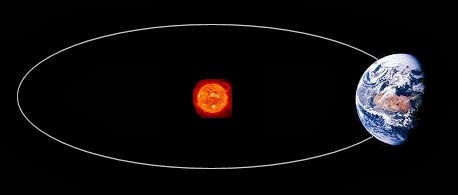
Here in this picture we see that that Earth actually revolves around the sun in an ellipse motion and it isn't perfectly circular. "The radius of this orbit is 150 million km (which is, of course, the distance to the Sun.) and it takes a YEAR (365¼ days), for the Earth to complete ONE orbit, to fit this into the calendar we have 365 days for three years and then 366 days for a leap year." (www.telescope.org/nuffield/pas/earth/earth5.html)
http://en.wikipedia.org/wiki/Ellipse
4. Citations
(www.telescope.org/nuffield/pas/earth/earth5.html)
www.youtube.com/watch?v=6pDh42E2bbA
http://www.mathopenref.com/ellipsefoci.html
(www.telescope.org/nuffield/pas/earth/earth5.html)
www.youtube.com/watch?v=6pDh42E2bbA
http://www.mathopenref.com/ellipsefoci.html
http://en.wikipedia.org/wiki/Ellipse
Monday, December 9, 2013
SP #6: Unit K Concept 10: Writing a repeating decimal as a rational number using geometric series

Wednesday, November 13, 2013
SV#5 Unit J: Concept 3-4
What should you be careful about? Everything! There are small mistakes that people do a lot and I don't want you guys to do a small mistake! But when you're watching my video please be really be careful when I change the signs when I'm doing the elementary row operations, which in fact have confused a lot of people in the past so yeah. :P Be careful! But other than that I think you guys should be okay! :D
Student Video #3 Unit H Concept 7 : Finding logs given approximations
Hey you guys! The tip that I'm going to give you guys tonight is that you should really be careful with the fraction because REMEMBER ! When we have a fraction and we're already done with solving the numerator be really careful after solving that because it converts into a negative! You should also really look out for the hand movements because it shows you what I'm doing as I'm speaking. But yeah. That's about it! Thanks for watching my video. :)
Monday, October 7, 2013
SV#2: Unit G Concepts 1-7 - Finding all parts and graphing a rational function
To graph a rational function, you find the asymptotes and the intercepts, plot a few points, and then sketch in the graph. Once you get the swing of things, rational functions are actually fairly simple to graph. Let's work through a problem.
• When you draw your graph, make sure you show the graph continuing off to the sides.
• Don't just stop at a point you've drawn, because this will make it look as though the graph actually stops at that point.
• Warning: Your calculator may display a misleading graph for a given rational function. When you graph, you plot some points and then you connect them. Your calculator does the same thing. But you're smart enough to know not to cross a vertical asymptote. Your calculator isn't that intelligent.
Subscribe to:
Posts (Atom)